
Building Habits With ADHD | Black to Basics
Building habits with ADHD is an executive function problem, not a motivation problem. The brain does not resist routine because it is undisciplined. It resists because habits require consistent initiation, and initiation is a cognitive skill that breaks down when executive dysfunction is present. What works is a system that removes decisions in advance, reduces friction at the point of starting, and replaces willpower with environmental design.
(This isn't actually an article about running. Unless of course, you're a runner.😉)
You know what you need to do. You just can't make yourself do it. Why do I know what to do but can't make myself do it? That's not a motivation problem. That's executive function. Running is how I started to figure it out long before I knew I have ADHD, and it completely changed how I look at building executive function and ADHD habits.
Well... unless you're a runner. Then maybe you already knew.
Every year, when I decide it's time to train for another 10K, I don't start from scratch. I don't search for a new training plan. I don't wait until I feel motivated. I come back to the same system I've trusted for years, because I know the first week will feel hard, I know my brain will negotiate, and I know there will be mornings when I'd rather stay in bed.
A few weeks ago, somewhere around the two-kilometre mark, that little voice showed up right on schedule. "Skip today. You'll make it up tomorrow."
I smiled. Not because running has become easy, but because I've heard those thoughts so many times that I no longer believe them. I kept running. Not because I won the argument, but because the system had already made the decision for me.
That's one of the biggest things running ever taught me. Not how to run. How my brain works.
Long before I knew I had ADHD, and long before I understood executive function, I was building habits that quietly supported my brain. I just didn't have the language for it yet. Here are seven things I learned on the road that turned out to be lessons about executive function all along.
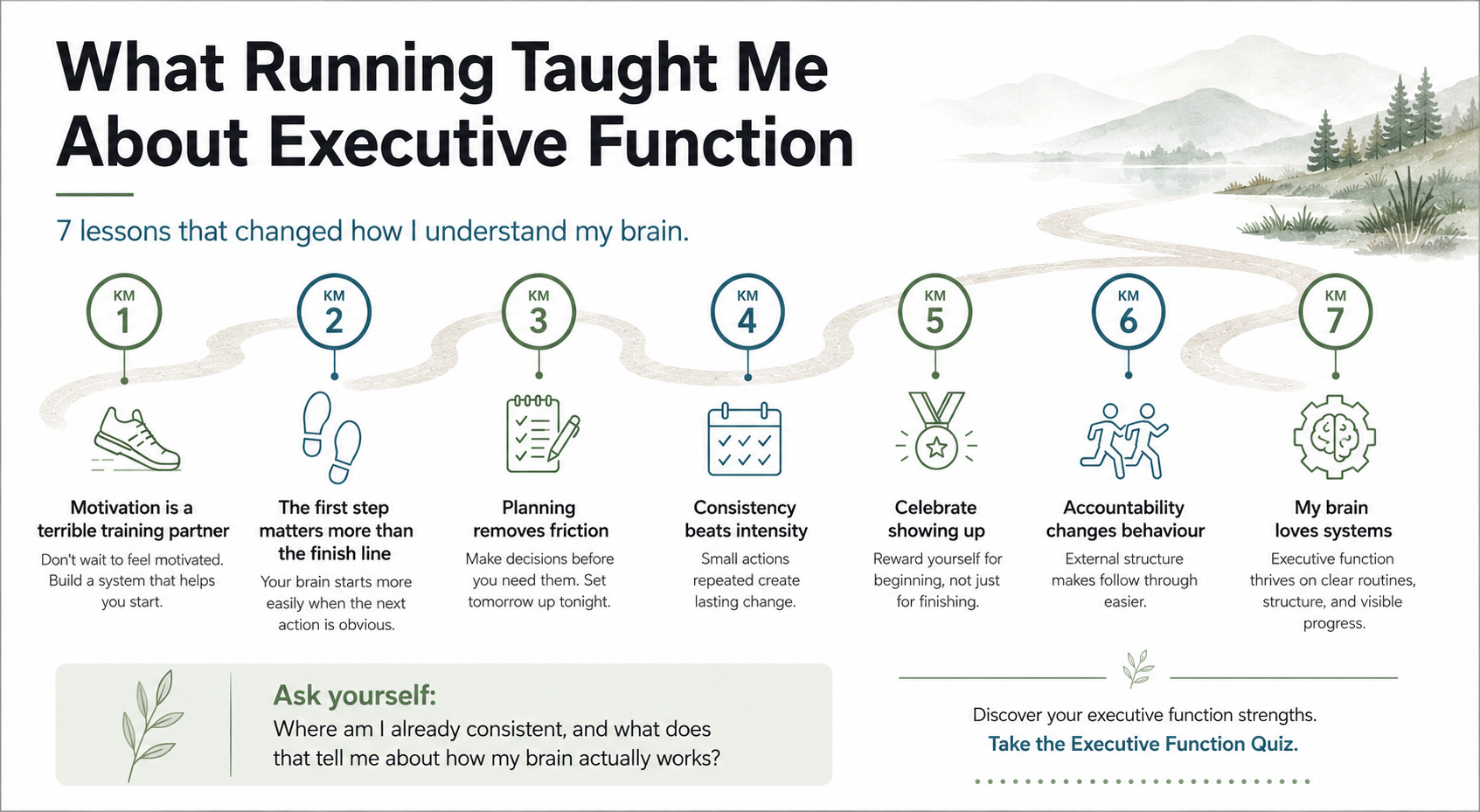
1. Motivation is a terrible training partner.
1. Motivation is a terrible partner (How to start a task with ADHD)
Some days I couldn't wait to get out the door. Other days I negotiated with myself before I'd even tied my shoes, running through every reason why today was a bad day for a run and why tomorrow would be better.
If I'd waited until I felt motivated, I never would have trained for a race. What I learned instead is that motivation is a feeling, and feelings are unreliable. They show up when they want to and disappear when you need them most.
This is exactly what executive function research tells us about initiation; the brain's ability to start a task. For most people, and especially for those of us trying to figure out how to start a task with ADHD, initiation doesn't run on interest or intention. It runs on structure. The plan that's already in place, the shoes already by the door, the route already decided. When the system does the deciding, your motivation doesn't have to.
2. The first step matters more than the finish line.
I didn't train for a 10K by thinking about 10 kilometres. I thought about today's run, today's weather, and whether I could just get outside and start moving. Once I was moving, the rest usually took care of itself.
The same thing happens at work. When we look at the whole project, the whole report, the whole difficult conversation we've been avoiding, our brain often stalls completely. It's not laziness. It's a working memory and planning challenge. The brain struggles to hold the full scope of a complex task and simultaneously figure out how to begin it.
When we focus on the first step only, something shifts. The brain can handle one concrete action. It can't always handle the whole thing at once. So the question isn't "how do I finish this?" It's "what is the very first thing I need to do?" That's the question that gets you moving.

3. Planning removes friction (Beating ADHD decision fatigue)
The night before a run, I lay out my clothes. I decide on my route. I make sure my watch is charged. None of those things make me faster or stronger. What they do is remove the decisions I'd otherwise have to make at 6am when my brain is barely online.
This is ADHD decision fatigue in action. Executive function draws on a finite daily resource, and every small decision we make draws from that same pool. By the time we've navigated a full morning of emails, interruptions, and small choices, there's often very little left for the thinking work we actually intended to do.
Laying out your running clothes the night before is, at its core, a cognitive load strategy. You're doing the thinking when you have capacity, so that future-you doesn't have to. The same principle applies to your workday. When you plan tomorrow's priorities before you close your laptop tonight, you're not just being organized. You're protecting your brain's resources for the work that actually requires them.
4. Consistency beats intensity (How to build consistency with ADHD)
Not every run was fast. Some felt terrible from start to finish. Some I cut short. And for a long time, I thought those runs didn't count, that only the good ones were building something.
I was wrong. The runs that almost didn't happen were often the most important ones, not because of what they did for my fitness, but because of what they did for the habit. Every time I showed up when I didn't feel like it, I gave my brain evidence that this is what we do. We run on Tuesdays. That's just who we are.
People often ask, “How do you build consistency when you have ADHD?” The answer is that the goal isn't a perfect week. It's a reliable pattern. When we build consistency, even imperfect consistency, we're reducing the cognitive overhead of deciding whether to do the thing at all. Eventually, the habit does what motivation never could. It makes the decision automatic.
5. Celebrate showing up.
For years, I celebrated race medals and finish times. Then I started paying attention to something else: the runs that almost didn't happen. The ones where I talked myself out of bed, laced up anyway, and went.
Those became the ones I was most proud of, because those are the runs that actually build the habit. The easy runs maintain it. The hard-to-start runs create it.
Our brains learn from evidence. When we acknowledge that we showed up, especially on a hard day, we're reinforcing the neural pathway that says showing up is what we do. This is why celebrating small wins isn't just feel-good advice. It's how habits become durable. If you only celebrate the big outcomes, your brain never gets the signal that the daily effort matters. It does. Arguably, it matters more.
6. Accountability changes behaviour. (The power of external accountability)
Running with a friend almost guaranteed I'd show up, even on days when I absolutely would have cancelled on myself. Signing up for a race changed how I trained for months in advance. Something about having an external commitment shifted the entire equation.
This isn't a personality quirk. It's how executive function actually works for a lot of us, and leveraging external accountability for ADHD can be a total game-changer. When accountability is internal only, we're relying on our own brain to generate the urgency to begin. For many people, that internal urgency is inconsistent at best.
External accountability creates a structure that the brain can respond to. It's not a workaround or a crutch. It's one of the oldest and most effective behaviour-change strategies we have, and there is nothing wrong with using it deliberately. Running partners, coaches, colleagues, check-ins, deadlines set by someone else: these aren't signs that you can't manage yourself. They're signs that you understand how your brain works.
7. My brain loves systems. (Building systems for the ADHD brain)
For years, I thought I loved running. I talked about it like it was a passion, like something about the sport itself called to me.
Looking back, I think what I actually loved was what running gave my brain: a clear structure, a predictable routine, a defined next step, and progress I could measure. Running didn't ask my brain to figure out what to do. It already knew. Tuesdays and Thursdays, same route, same time. The only decision was whether to go.
When I eventually learned about executive function, and later about my own ADHD diagnosis, it all made sense. Running wasn't fixing my brain. It was supporting it. This is executive dysfunction habit building in practice: not fighting the brain's resistance, but designing around it. I was accidentally building systems for an ADHD brain that gave my executive function system exactly what it needed to work well: low ambiguity, clear sequence, external commitment, and visible progress.
The question worth asking
Today, I see this same pattern in almost every professional I work with. Most people already have one area of their life where they've accidentally built a system that works beautifully. Running happened to be mine.
Yours might be cooking. It might be managing client projects, planning travel, or something you've been doing so long you've never stopped to examine it. Whatever it is, it's not an accident. Your brain found something that worked, and it kept coming back.
So instead of asking, "Why can't I be more consistent?" try asking this instead: "Where am I already consistent, and what does that tell me about how my brain actually works?"
That question has taught me more than any productivity book ever has.
If you're curious about your own executive function patterns, I've created a short quiz that will help you identify where your brain naturally shines and where it might need a little more support. It takes about four minutes, and it gives you something specific to work with.
Because the goal isn't to become someone else. It's to build more of what already works.
Frequently Asked Questions
Why is building habits harder with ADHD?
ADHD affects the executive functions that habits depend on: initiation, working memory, and follow-through. Habit formation requires consistent repetition, but each repetition requires the brain to initiate the behaviour again. For ADHD brains, that initiation cost is higher than average. This is why motivation-based advice ("just do it every day") fails — it assumes initiation is easy. For many people, it is the hardest part.
What is ADHD decision fatigue and how does it affect productivity?
Decision fatigue occurs when repeated decisions deplete the cognitive resources available for subsequent choices. For professionals with ADHD, this happens faster and earlier in the day. Each small decision — what to work on first, where to sit, which task to open — draws from the same limited executive function resource. Reducing decisions in advance, by planning the night before or building a fixed routine, preserves that capacity for work that actually requires it.
Does external accountability really work for ADHD?
Yes, and it is neurologically explained. Internal accountability relies on the brain generating its own urgency to begin. For ADHD brains, that internal signal is inconsistent. External accountability — a coach, a deadline set by someone else, a commitment to another person — creates an external urgency the brain can respond to reliably. It is not a workaround. It is one of the most evidence-supported behaviour change strategies available.
How do you build consistency when you have ADHD?
Consistency with ADHD comes from reducing the cognitive overhead of deciding whether to do the thing, not from increasing willpower. Fixed schedules, environmental cues, pre-made decisions, and low-friction setups all reduce the initiation cost of repeating a behaviour. The goal is to make the habit easier to start than to skip — not through discipline, but through design.
What does executive function have to do with building habits?
Habits are built through repeated initiation, which is an executive function. Planning the next step, remembering the goal, suppressing competing impulses, and starting the behaviour all draw on executive function systems. When those systems are compromised — by ADHD, cognitive overload, or high stress — habit formation is slower and less reliable. Designing the environment to do some of that cognitive work removes the dependency on executive function in the moment.
About the Author
Shari Black is an Executive Function Consultant and ADHD Coach (ICF-PCC) based in Ontario, Canada. With 25 years of private sector and nonprofit executive leadership, including time as a CEO and Executive Director, she founded Black to Basics to help professionals and entrepreneurs close the gap between knowing what to do and actually doing it. As someone with lived ADHD experience, she brings both professional expertise and personal insight to every client engagement. She works with clients across North America. Learn more at blacktobasics.ca.
